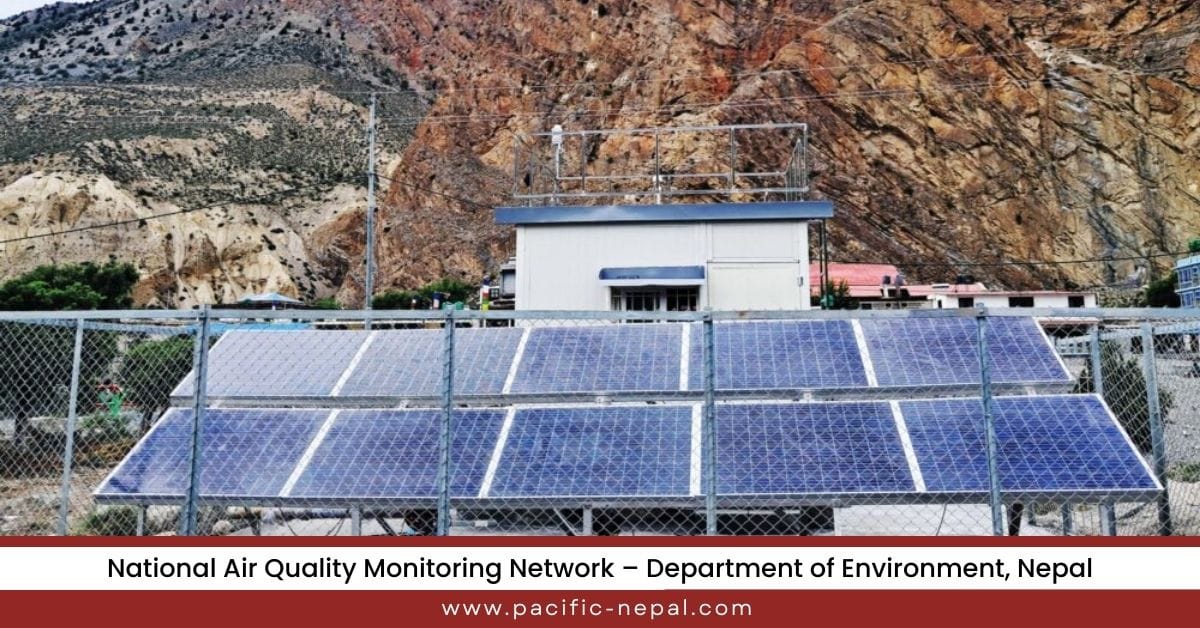
KATHMANDU, NEPAL — In a groundbreaking environmental initiative, Pacific Group has successfully completed the nationwide deployment of Nepal’s first integrated Air Quality Monitoring System (AQMS) — installing over 20 real-time monitoring stations stretching from Rara in the Far-West to Dhankuta in the East, under contract with the Department of Environment, Government of Nepal.
This landmark project — powered by precision German-engineered sensors from GRIMM (a Durag Group company) — establishes Nepal’s first scientific, data-driven infrastructure for tracking ambient air pollution across diverse geographies: from Kathmandu’s urban smog to the pristine air of high-altitude Himalayan regions.
Why This System Changes Everything for Nepal
For the first time, Nepal now has the ability to:
✅ Measure Real-Time Air Quality — Track PM2.5, PM10, NO₂, SO₂, O₃, CO, and other pollutants continuously, 24/7.
✅ Compare Urban vs. Rural Air — Understand pollution gradients from Kathmandu Valley to remote mountain districts.
✅ Support Public Health Research — Link air data to respiratory illness trends, school absenteeism, and hospital admissions.
✅ Inform Policy & Regulation — Empower the government to design targeted emission controls, traffic policies, and industrial zoning.
✅ Alert the Public — Lay the groundwork for public air quality index (AQI) dashboards and health advisories.
At the heart of the network sits a central calibration tower with a master control unit — ensuring all 20+ stations remain accurate, synchronized, and scientifically reliable over time.
“Air doesn’t respect borders — and neither should our monitoring,” said a Pacific Group project manager. “From the lakes of Rara to the hills of Dhankuta, this system gives Nepal its first true picture of what we’re breathing. It’s not just data — it’s the foundation for healthier communities, smarter cities, and evidence-based environmental laws. We’re proud to have turned this national vision into reality.”
Other Projects
- Quest Pharmaceuticals Earns Prestigious LIVING LAB Certification from Shimadzu Asia Pacific
- Pacific Commercial Company Partners with Shimadzu Asia Pacific and MBUST to Strengthen Nepal’s Scientific Research
- Launch of Hamilton Beach Fans in Nepal
- Introduction of SHARP Plasmacluster Air Purifiers in Nepal
- ADS-B Surveillance System – Tribhuvan International Airport, Kathmandu
- Debt Operation and Management System – Ministry of Finance, Nepal
- National Air Quality Monitoring Network – Department of Environment, Nepal
- Nepal’s First Automated LCMSMS Clinical Testing Facility Goes Live at Tribhuvan University Teaching Hospital
- Supply and Installation of CNS, ATM & AWOS at Gautam Buddha International Airport